


How a Crypto Lawyer Can Convince Global Law Enforcement to Investigate a Particular Crypto Scam Case

The cryptocurrency industry has created unprecedented opportunities for innovation, investment, and financial inclusion. Unfortunately, it has also become a target for sophisticated fraudsters operating across multiple jurisdictions. One of the greatest frustrations faced by crypto scam victims is the belief that law enforcement agencies will not investigate their case, particularly when the scammers are located overseas.
In reality, many successful international cryptocurrency investigations begin with a properly documented legal submission. An experienced crypto lawyer can often play a critical role in transforming scattered victim complaints into a legally compelling case that attracts the attention of regulators, financial intelligence units, cybercrime divisions, and international law enforcement agencies.
Understanding the Challenge
Cryptocurrency scams are rarely confined to one country. A typical fraud may involve:
Victims located in multiple jurisdictions.
Cryptocurrency exchanges operating in different countries.
Bank accounts spread across several financial institutions.
Shell companies incorporated offshore.
Fraudsters using mixers, decentralized protocols, and privacy tools.
Because of this complexity, law enforcement agencies often require substantial evidence before allocating resources to an investigation.
The Lawyer's Role: Turning Allegations into Evidence
A crypto lawyer does far more than submit a complaint.
The objective is to present evidence in a format that demonstrates:
Criminal conduct.
Identifiable suspects or infrastructure.
Traceable financial flows.
Potential recovery opportunities.
Public interest and victim impact.
Modern blockchain forensic tools can trace transactions across multiple wallets and exchanges, providing investigators with actionable intelligence.
Academic research confirms that blockchain analytics and evidential standards play an increasingly important role in cryptocurrency investigations and prosecutions.
Building a Comprehensive Investigation Package
A well-prepared legal package may include:
1. Blockchain Analysis
The lawyer may work with blockchain forensic specialists to identify:
Wallet addresses
Transaction hashes
Exchange deposit addresses
Cross-chain movements
Mixer usage
Stablecoin transfers
2. Victim Statements
Multiple victim declarations can establish:
Common scam methodology
Similar communications
Shared wallet destinations
Consistent fraudulent representations
3. Corporate Intelligence
Investigations frequently uncover:
Shell companies
Nominee directors
Fraudulent licensing claims
False regulatory representations
4. Regulatory Violations
The lawyer may identify violations involving:
Securities laws
Anti-money laundering regulations
Consumer protection laws
Financial services licensing requirements
Why Law Enforcement Takes Some Cases More Seriously
Authorities are generally more likely to investigate when evidence shows:
Large financial losses
Multiple victims
Organized criminal activity
Cross-border money laundering
Ongoing victimization
Links to known criminal networks
The FBI reports that cryptocurrency-related fraud remains one of the most costly forms of cyber-enabled crime, generating billions of dollars in reported losses annually.
Engaging International Authorities
An experienced crypto lawyer may submit evidence to:
National Financial Intelligence Units (FIUs)
Securities regulators
Cybercrime task forces
Anti-money laundering authorities
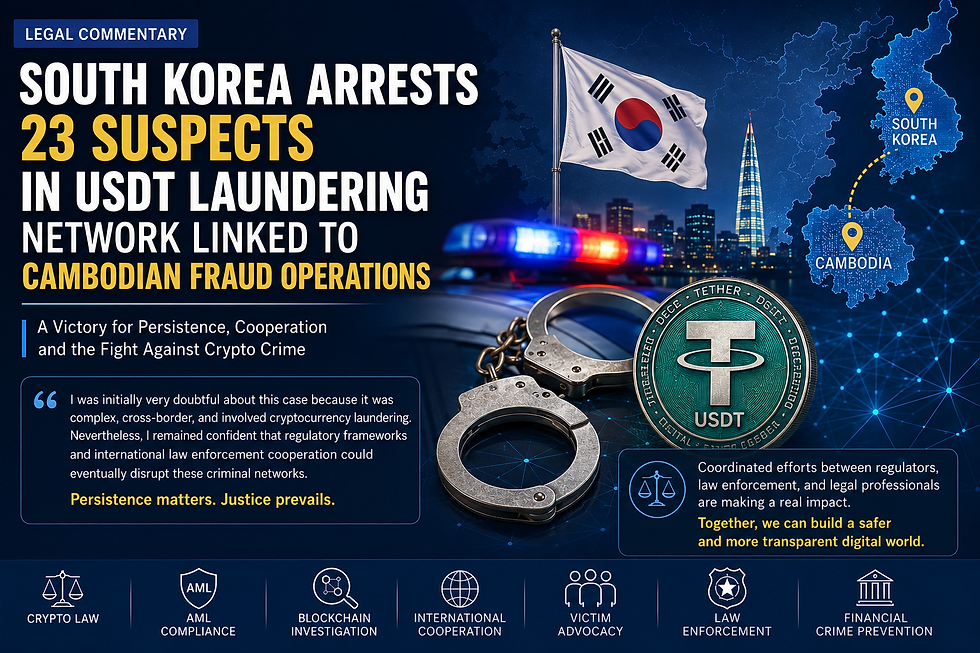
International cooperation has become increasingly common in major cryptocurrency investigations. Recent enforcement actions have demonstrated that agencies from multiple countries can successfully coordinate against cross-border crypto fraud networks.
Presenting Recovery Opportunities
Law enforcement agencies are more likely to act when there is a realistic prospect of:
Asset freezing
Exchange intervention
Wallet identification
Recovery of stolen funds
Criminal prosecution
The FBI specifically encourages victims to provide wallet addresses, transaction records, exchange information, and supporting evidence to facilitate investigations.
The Importance of Professional Documentation
Many complaints fail because they contain:
Emotional arguments
Unsupported allegations
Missing transaction records
Incomplete evidence
A crypto lawyer helps ensure that the submission:
Is legally structured.
Contains admissible evidence.
Demonstrates jurisdiction.
Identifies responsible parties.
Highlights regulatory breaches.
This significantly improves the likelihood that authorities will review the matter seriously.
Conclusion
Contrary to popular belief, cryptocurrency scams are not beyond the reach of law enforcement. The key is presenting a case that is evidence-driven, professionally documented, and legally persuasive.
A skilled crypto lawyer can bridge the gap between victims and authorities by converting blockchain data, victim testimony, financial records, and regulatory violations into a coherent investigative package. When properly prepared, even highly complex international crypto fraud cases can attract the attention of regulators, financial intelligence units, and global law enforcement agencies.
As cryptocurrency enforcement capabilities continue to expand worldwide, professionally prepared complaints are increasingly becoming the foundation upon which successful investigations and asset recovery efforts are built.
Disclaimer
The information provided in this article is intended for general informational purposes only and should not be construed as legal or financial advice. Readers are encouraged to seek independent professional counsel tailored to their specific circumstances.
Author & Crypto Consultant
Shahid Jamal Tubrazy – Crypto & Fintech Law Consultant
Shahid Jamal Tubrazy is a recognized professional in the field of cryptocurrency and blockchain law, with specialized certification in Crypto Law from Duke University. As an experienced fintech lawyer, he provides comprehensive legal services across the digital asset ecosystem, including regulatory licensing, legal structuring for ICOs, STOs, DeFi projects, and DAOs.
He also offers expertise in crypto dispute resolution, mediation, negotiation, and mergers & acquisitions within the blockchain sector. With a strong portfolio of published work on blockchain regulation and cryptocurrency law, Shahid delivers practical legal insights to help clients navigate complex regulatory landscapes, ensure compliance, and achieve strategic growth in the evolving fintech industry.
📧 Email: shahidtubrazy@gmail.com
📘 Facebook: https://www.facebook.com/fintechcryptolawyer
📝 Blogger: https://sjtubrazylegalpages.blogspot.com/


Comments